

An amazing picture of Durban taken by Magda Ehlers Photography.
Prefer to listen? Here are the key points from me in under a minute.
Read the transcript
Hi, Joshua here. In this article I talk about how to get found on Google as a Durban business. This is what I know. Start with what your customers actually type in. Someone searching “pizza near me” wants something different from someone searching “best curry Durban”, so build your pages and your Google profile around those searches. Give every page one focus keyword. Put it in your title, your meta description, your main heading and your URL. Then answer the question in the very first sentence. People skim, and so does Google. Be picky about whose advice you follow, too. Good SEO advice should be useful even if you never pay the person who gave it. If you’d like to learn more, keep reading.
In short
- Getting found on Google starts with knowing what your customers type in, then building your pages and Google Business Profile around those searches.
- Be picky about whose SEO advice you follow. Good advice is useful even if you never pay for it, fits your area, and is backed up by credible sources.
- Keep your Google Business Profile complete and active, keep the reviews coming, and list your business on local directories with the same details everywhere.
- On every page, pick one focus keyword, put it in your title, meta description, H1 and URL, answer the question straight away, and link your pages together.
- SEO usually takes four months to a year to pay off, so patience and consistency matter more than quick fixes.
- AI is changing how people search, but useful, original websites still matter, because AI tools get their answers from them.
You get found on Google by understanding what your customers search for, then showing up for those searches with the right content and, in most cases, a well-managed Google Business Profile. There’s no one-size-fits-all approach, and good search engine optimisation (SEO) is a long-term play.
You’re looking to get found on Google but aren’t sure where to start. There’s a lot of differing advice out there. Research online and you’ll find plenty of courses, YouTube videos, and web articles (and a lot of snake oil). What’s right for you and your business depends on a few things. I’ll start with how to choose whose advice to listen to.
Want a straight answer for your business? I offer SEO services in Durban with a free first chat.
Whose SEO advice should you listen to?
Start with where the advice is coming from. That matters with SEO, where everybody feels like an expert.
Are they trying to sell you something?
I think this is the most important question, and yes, I sell SEO services too. Selling something doesn’t make advice bad. What matters is whether the advice holds up on its own. Good advice should still be useful even if you never hire the person who gave it.
Be careful when the useful part is always held back until you pay, or when every answer leads to the same product. A good adviser will tell you what you can do yourself, and will be upfront when their service isn’t the right fit.
Do they understand your business and your area?
SEO is not one-size-fits-all. Local business SEO looks different depending on the area you’re in and the nature of business there. Strategies like local citations also differ from place to place. It’s important to listen to people who are based where you’re based.
Is your research specific, and is it verified?
Get as specific as possible when you’re doing research. AI tools are very helpful for this. Don’t take every word as fact, though. Ask it to reference credible sources so you can check what it says.
Google says this about its own AI. Its help page says AI Overviews “can and will make mistakes” and advises checking important info in more than one place.
Getting good advice on SEO and getting found on Google depends on quite a few variables. These three are the most important.
How do I get found on Google in Durban?
It depends on your business, because, as I’ll keep repeating, there’s no one-size-fits-all solution. Let’s say you’re starting a new restaurant in Durban. You want to get above your competitors, and you want people to find you. Your strategy will look very different from a plumber’s or an accountant’s.
Start with how people search
Consider how people find restaurants. They search for things like:
- pizza near me
- pizza Durban
- best curry Durban
Google uses this exact example. It explains that it recognises when a search has local intent, so a search for “pizza” shows nearby businesses.

How you get onto the search results pages (SERPs) depends on the types of queries people use.
If somebody searches “best curry Durban”, you’ll probably want to create a piece of content for it, or get featured on a listicle that already ranks for that query. That might involve outreach. It might also involve creating unique content on your own site. Whatever it is, understand your users first and foremost.
Keep your Google Business Profile up to date
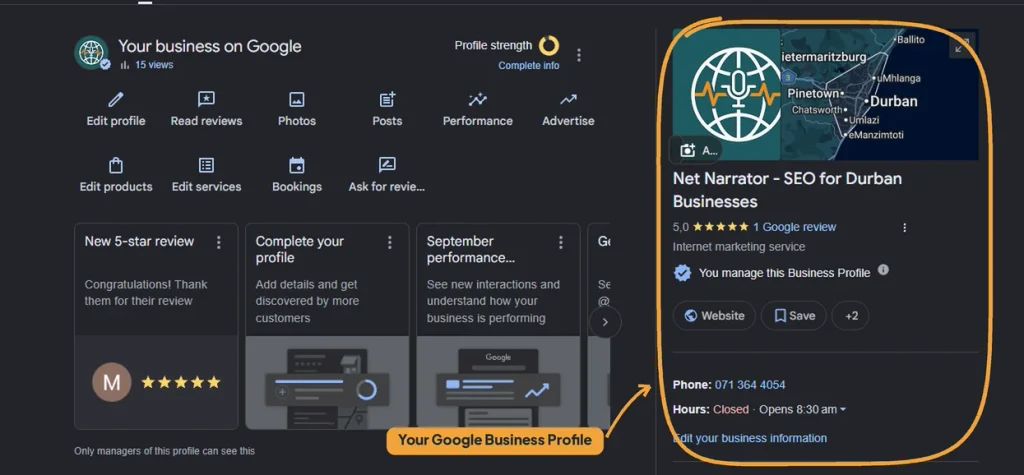
For restaurants especially, your Google Business Profile likely drives the majority of your enquiries. Make sure it’s optimised and that you have a long-term strategy for getting reviews.
Manage it regularly with new posts and pictures. Keep it up to date so it mirrors your website.
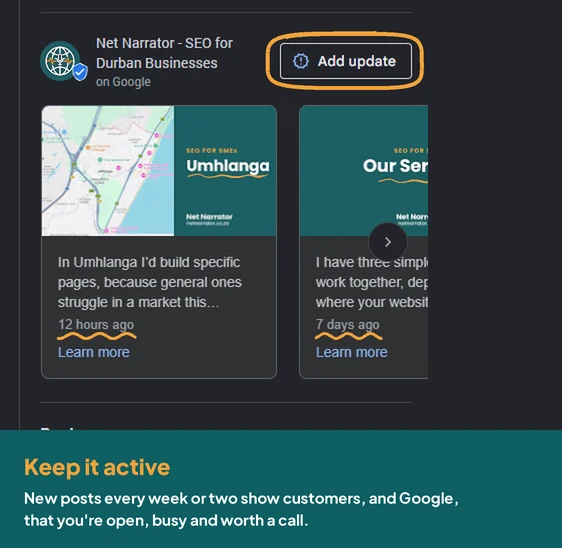
Google’s own guidance backs this up. According to Google Business Profile Help, businesses with complete and accurate info are more likely to show up in local results. It also says more reviews and positive ratings can help your local ranking.
Get listed on local citations
Getting listed on local citation sites is a great way to get found on Google in Durban. A citation is any online mention of your business name, address and phone number, usually on a directory.
Think of directories like Yellow Pages and relevant industry-specific websites. Some of these point back to your website with what’s known as a do-follow link. That passes link equity, or “link juice”, from their website to yours. That’s the kind of link you want.
Mentions and links without that link juice still help. The more places your business is referenced, the better search engines and AI tools understand what you do and where you are.
Google confirms that mentions count as well as links. It says one of the factors it uses to judge quality is whether other prominent websites link or refer to the content.
The takeaway for every business: set up your local citations, and get referenced on as many high-quality websites as you can.
To start, you can list your business on these South African directories:
Use exactly the same business name, address, phone number and website on every one.
Create assets worth sharing
Creating assets worth sharing is another valuable way to build your business on Google. These could be web articles, videos you host on your website, or whatever suits your business. Create high-quality, shareable material that other websites can reference and use in their own research.
Google relies on trust signals and external references. With enough external references, you can beat your competitors and push yourself up the search listings.
Not sure what would work for your business? WhatsApp me for a free first chat.
What does a basic SEO strategy look like?
A basic SEO strategy comes down to a few habits: give every page one search term to focus on, put that term where Google looks first, and link your pages together so people and Google can find their way around. You don’t need to be technical to start.
Pick one focus keyword per page
A focus keyword is the main search term you want a page to show up for, like “plumber in Umhlanga”. Each page should have its own. If two pages chase the same keyword, they compete with each other, and neither does as well.
Put your keyword in your headings and metas
Once you know the keyword, put it in the places Google reads first:
- Title tag: the blue, clickable headline in Google’s results. Keep it to about 60 characters, with the keyword first, then something that earns trust, then your business name.
- Meta description: the short summary under the title. Aim for 150 to 155 characters, with the keyword, a reason to click and a short call to action.
- H1: the main heading on the page itself. It should say what the page is about and include the keyword.
- URL (slug): the end of the web address. Keep it short, lowercase and with the keyword, like /plumber-umhlanga/.
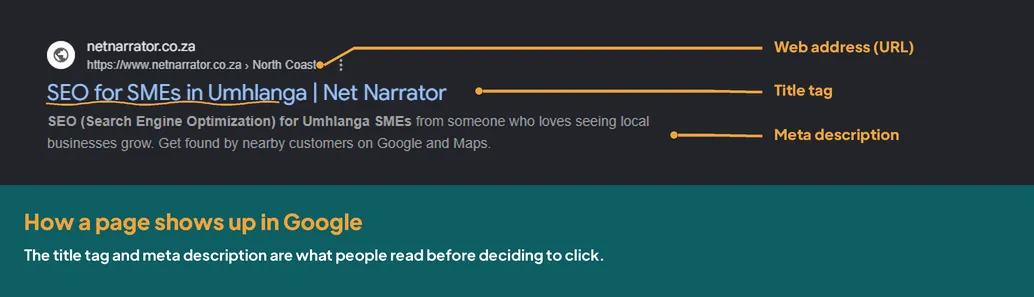
If your site runs on WordPress, a plugin like Yoast SEO lets you fill in the title tag and meta description for each page. Google doesn’t always show your meta description word for word. It says it sometimes uses the meta description when it describes the page better than the page text does, so a good one is still worth writing.
Answer the question straight away
Under each heading, answer the question in the first sentence. People skim, and so does Google. If your heading asks “How much does a geyser replacement cost in Durban?”, the next line should give the answer.
Link your pages to each other
Internal links are links from one page on your website to another. They help visitors find what they need, and they show Google which pages matter and how they relate. A few rules I follow:
- link to a page wherever its topic comes up naturally in your writing, as well as in the menu
- use descriptive link text, like “geyser repairs in Durban North”, instead of “click here”
- aim for every page to have three to five links pointing to it from other pages
- make sure no page is left with nothing linking to it
This post does it too. Where my work comes up, it links to my SEO services page.
Answer the questions people actually ask
Look at the questions people ask about your service, in Google’s “People also ask” box or from your own customers, and answer four to six of them on the page. It helps your customers, and it gives Google and AI tools clear answers to pull from.
None of this needs a big budget. It needs consistency, and someone checking that every new page follows the same rules.
How long does SEO take?
Research shows it can take anywhere from a couple of months to a year to get good long-term results from SEO. Google says the same. In its official video on how to hire an SEO, Google explains that SEOs usually need four months to a year to implement improvements and see a benefit.
Ranking new pages is getting harder, too. An Ahrefs study found that only 1.74% of newly published pages reached Google’s top 10 within a year.
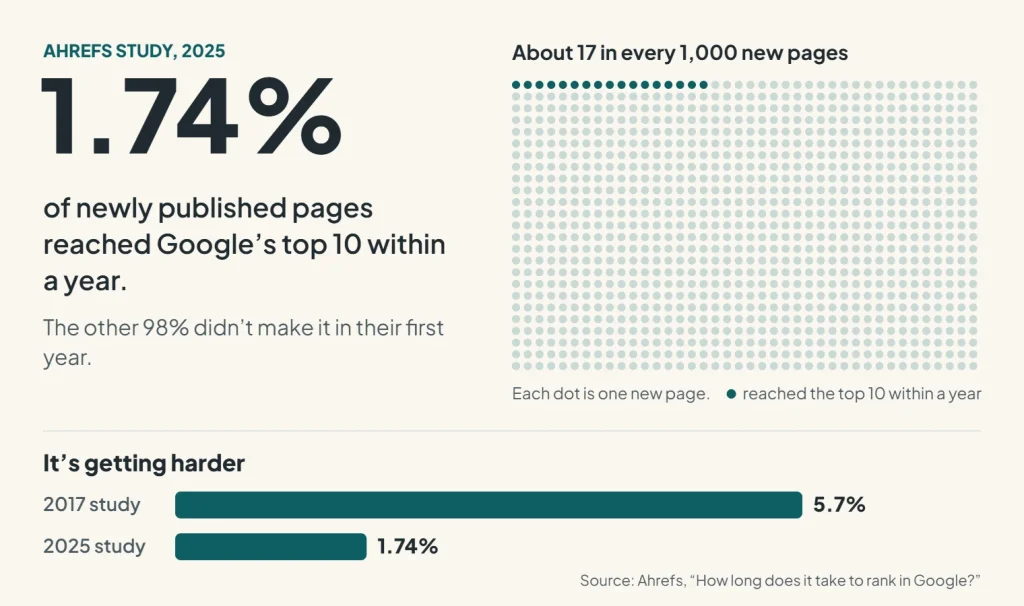
SEO isn’t something that can be done overnight. There are short-term plays, which in the business we call “quick wins”, and long-term plays. Every SEO strategy is a long-term strategy. Quick wins just provide some ROI along the way.
Timelines aren’t the whole picture, though. In my experience, you need to be prepared for SEO in the long term. You need to be ready to ride the waves, so to speak. There will be ebbs and flows, particularly for very new websites.
If you’re willing to stick it out, your rankings will eventually settle. Enjoy the highs, take action, and be patient during the lows. That happens once:
- Google has decided where you sit in the competitive landscape
- Google has assessed enough user behaviour on your website
- you’ve responded appropriately and consistently to underperforming pages, site issues and the like
That second point is Google’s own description. It says it uses anonymised interaction data to judge whether search results are relevant to a search.
Then you can expect positive results.
Most people aren’t willing to do what it takes to build a high-performing website, and that’s the truth. If you want to get found on Google, the most important things are patience, consistency and someone who knows what they’re doing. A website becomes a long-term asset that generates business for you for years to come. With the right maintenance, it can stay that way.
Will SEO change as AI evolves?
Yes, SEO is going to change as AI evolves. In fact, we’re already seeing it. Google’s AI Overviews and large language models (LLMs) like Claude, Gemini, Grok and ChatGPT are affecting the landscape significantly. So are various other AI services and tools.
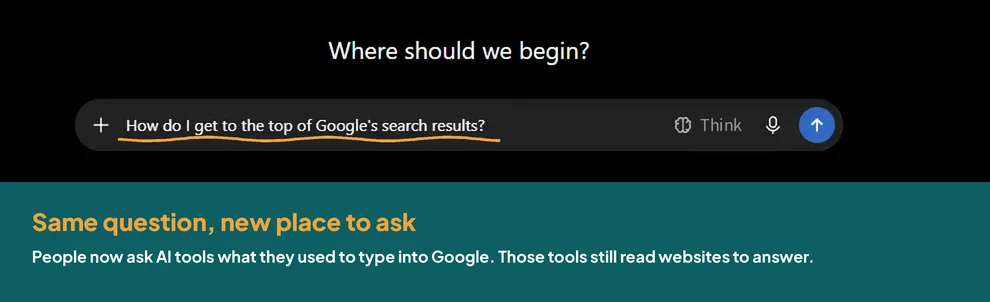
The fundamentals won’t change, though: content made for the people using it. In my opinion, a high-quality website will remain valuable. That means one with information that doesn’t exist elsewhere, that answers users’ queries effectively, and that is designed with the user in mind.
Google agrees. Its guide to AI features and your website says the best practices for SEO still apply to AI Overviews and AI Mode, with no extra requirements. Its guide to helpful content asks whether your content offers original information, research or analysis.
Remember, Google doesn’t exist without users. AI tools have no information unless there are websites to gather it from, so websites will always be vital. What they look like in future, or at least how you access them, may change.
For example, I suspect Google may evolve into something very AI-centric. Instead of doing direct Google searches most of the time, you may just talk to the bot. It will direct you, and possibly even perform actions for you, like bookings and purchases.
It’s already starting here. In April 2026, Google announced that AI Mode in South Africa can search booking platforms for real-time restaurant availability, then link you straight through to book.
Google is going to evolve, but websites remain vital.
Questions Durban business owners ask about Google
How much does it cost to get listed on Google?
Nothing. It costs nothing to appear in Google’s normal search results, and setting up a Google Business Profile is free too. Google says it never accepts money to include or rank sites in its search results. You only pay if you choose to run Google Ads, which show as sponsored results. The real cost of ranking well is the time and work it takes, whether that’s yours or someone you hire.
How do you get listed first on Google?
There’s no shortcut, and nobody can promise you the top spot. Google itself says no one can guarantee a #1 ranking, so be wary of anyone who does. What gets you there is being the most relevant, trusted answer for the search. For local searches, Google looks at how relevant your business is, how close it is to the person searching and how well known it is. Ads can put you above the normal results, but they’re labelled as sponsored and stop the moment you stop paying.
How much does SEO cost?
It depends on where your website is today, how competitive your industry and area are, and how much work is needed. A new restaurant in Umhlanga and a multi-branch business chasing all of Durban need very different amounts of work, so I don’t publish set packages. After a free first chat, I’ll give you a clear quote so you know exactly what you’re paying for.
How else, other than SEO, can I show up online?
There are a few ways, and most businesses use more than one:
- Google Ads, for paid listings at the top of search results
- your Google Business Profile, for Google Maps and local searches
- social media, such as Facebook and Instagram
- directories and listing sites, like Yellow Pages and the ones listed above
- local press, sponsorships and community groups that mention your business
SEO is the one that keeps working without paying for every click, which is why it pairs well with the others.
An SEO specialist can help your business grow
Look, I understand it’s an expense. I also understand that, especially the way the economy is going right now, adding another expense to your business can feel like a massive burden. However, we all know the trope: it takes money to make money. Unfortunately, investing in high-quality strategies costs money, but it can bring a huge return on investment.
South African businesses see this first-hand. In a report commissioned by Google, research firm Public First found that local businesses get 20% to 30% of their new customers through Google Search, on average.
If you’re interested, the first consultation with me is totally free. Get in touch, and we’ll go from there. If I find that SEO isn’t right for you, I’ll be clear about that as well. You can also see how my local SEO services work.