
A beautiful picture of Durban’s beachfront, taken by Marymodale on Pixabay.
Prefer to listen? Here are the key points from me in under a minute.
Read the transcript
Hi, Joshua here. In this article I talk about how to get your business found online. This is what I know. If you serve a local area, start with your Google Business Profile. It’s free, and it’s the quickest way onto Google Maps. Fill in every section and keep the reviews coming. Ads and SEO do different jobs. Ads get you seen from day one, which helps when you’re starting out, but they stop the moment you stop paying. SEO, while it is slower, keeps working for years, which is honestly why it’s my favourite. Get listed on local directories and with any industry association in your trade. Use exactly the same name, address and number on every single one. If you’d like to learn more, keep reading.
In short
- Getting found online usually means Google, which handles about 92% of searches in South Africa, but directories, social media, ads and AI tools all play a part.
- SEO is the best long-term way to get found, though it usually takes a few months to pay off.
- A complete, active Google Business Profile is the quickest win for local businesses.
- Directories and industry bodies get your name out there and can link back to your website.
- Social media works, but it needs good video, strong hooks and a lot of patience.
- Ads get you seen from day one, which is useful while SEO builds, but they stop the moment you stop paying.
Getting your business found online usually means showing up on Google, but there’s more than one way to do it. The main routes are search engine optimisation (SEO), a well-run Google Business Profile, local directories, social media and paid ads. The best approach mixes a few of them, depending on your business, your budget and how quickly you need results.
“How do I get found online?” is one of the most common questions I get, and it isn’t an easy one to answer, because there are so many ways to get “found”. So I’ll start with what people usually mean, walk through each option honestly, and finish with what I’d do first if I were starting from zero.
Want to know which route makes sense for your business? I offer SEO services in Durban with a free first chat.
What does “getting found online” actually mean?
For most business owners, it means one thing: when someone searches for what you do, your business shows up.
Nine times out of ten, they’re talking about Google. But getting found online is multifaceted. Customers might also find you through Google Maps, a directory listing, a post on Instagram, a video on TikTok or YouTube, an ad, or an answer from an AI tool like ChatGPT. Each of these works differently, and each needs a different kind of effort.
Start with the places people already look
Before you choose a channel, it helps to know where your customers actually are.
- Google: it handles about 92% of searches in South Africa. In a report commissioned by Google, research firm Public First found that local businesses get 20% to 30% of their new customers through Google Search, on average.
- Social media: South Africa had about 29 million social media user identities at the end of 2025, according to DataReportal.
- Maps and directories: Google Maps, Apple Maps, Bing and local directories all list businesses, and people use them to compare and find directions.
- AI tools: a growing number of people now ask ChatGPT, Gemini or Claude for recommendations instead of searching.
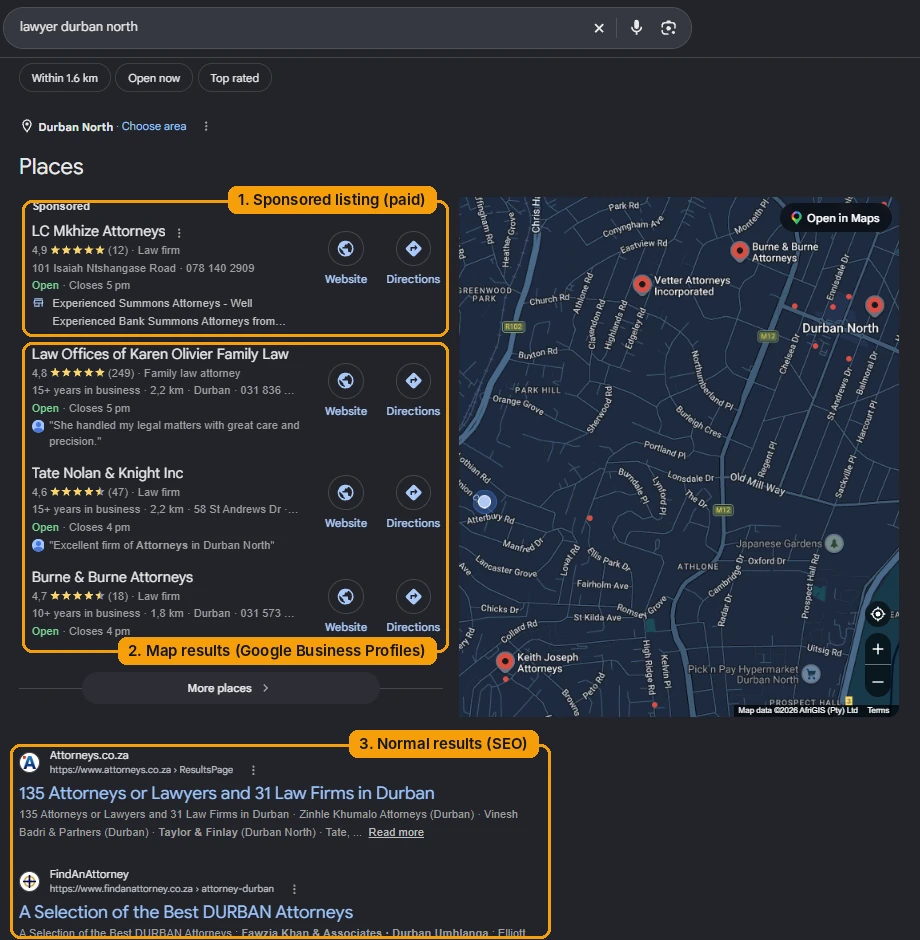
A single Google search shows how many of these overlap. Search for a lawyer in Durban North, for example, and you’ll see a sponsored listing at the top of the map results, then the other businesses on the map, then the normal results underneath. Each of those spots is a different way of getting found.
Search engine optimisation: my favourite way to get found
SEO is the best way to get found online, in my opinion, and the one I’d recommend for almost every business.
If you break down the words “search engine optimisation”, it explains itself. It’s optimising your presence on search engines so you show up when people search for what you offer. That includes your website, your Google Business Profile, your Bing Places listing, and even your Apple Maps listing through Apple Business Connect.
The catch is that SEO is a long-term endeavour. It usually takes a few months, sometimes up to a year, and it needs regular investment, a good strategy and attention to a lot of small details. The reward is that once it’s working, it keeps bringing in enquiries without you paying for every click. I explain the timeline in how long SEO takes to work, and the basics of ranking in how to get found on Google.
Your Google Business Profile is the quickest win
If you serve customers in a specific area, your Google Business Profile is the fastest way to start showing up. It’s free, and it’s what puts you on Google Maps and in the local results when people search “near me”.
Google says businesses with complete and accurate information are more likely to show up in local results, and that more reviews and positive ratings can help your local ranking. So fill in every section, choose the right categories, add real photos, post updates regularly and keep a steady stream of reviews coming in. Reviews do a lot of the work here: they build trust with customers and with Google at the same time.
I go into much more detail in how to show up in “near me” searches.
Do you need a website?
For SEO, yes. You can get found without one through social media, directories and your Business Profile, but a website is the foundation of SEO. It’s the one place online that you fully own and control.
A good website takes a lot of thinking. Beyond looking good, it needs:
- a clear user experience (UX), so people can find what they need without thinking about it
- design choices, like colour and layout, that make people trust you and want to get in touch
- fast-loading pages and properly optimised images
- content that’s kept up to date
Google rewards this kind of care. Its guidance on page experience says it wants to reward content that gives people a good experience. Having a high-quality website that’s regularly updated is one of the key tenets of SEO. If you’re weighing it up against a Facebook page, I cover that in do I need a website if I already have a Facebook page.
Your website has to say what you do and where
This sounds obvious, but it’s where a lot of Durban websites fall down. Your homepage and service pages should make it immediately clear what you do and which areas you serve.
“Quality solutions for every need” tells Google and your customers nothing. “Residential and commercial pest control in Durban North, Umhlanga and Ballito” tells them everything. Clear, specific wording helps people decide to call you, and it helps search engines and AI tools understand when to show you.
Get listed on local directories and industry bodies
Getting your business onto local directory sites is one of the easiest ways to get found, and I’d recommend it as part of any SEO or online marketing strategy.
You can go a step further and join associations or membership bodies related to your industry. For example, if you’re in pest control, research where pest controllers in South Africa can be listed, like the South African Pest Control Association (SAPCA), and get your business featured on those websites. Industry listings reach people who are already looking for your type of service, and they add credibility.
Some of these charge a fee, and even some local citation sites do. Plenty are free, though. Where you have a website, many will allow you to link back to it too, which helps your SEO as well. Google says one of the ways it judges quality is whether other prominent websites link or refer to the content. I list a few free South African directories to start with in how to get found on Google. Whatever you sign up for, use exactly the same business name, address and phone number everywhere.
Social media: video is king
Social media can absolutely get you found, but it’s a whole other ball game. It takes a clear strategy and plenty of patience.
My rule of thumb for modern social media: video is king, particularly short-form videos like Reels, TikToks and YouTube Shorts. Every video needs to start with a great hook. People’s attention spans are short, and if the first few seconds don’t grab them, they’ll scroll past. After that, the content needs to be genuinely useful or enjoyable, and you need to post consistently.

The good news is that social media and search support each other. Your profiles can show up when people search for your business name, and Google says videos can appear in several places in Google, including the main results and the Videos tab. It isn’t easy, but it is possible, and it can push you up on search engines too.
Can you get your business on Wikipedia?
Only if your business is well-known enough. Wikipedia has strict notability guidelines for companies, and a business generally needs significant coverage in independent, reliable sources, such as major news outlets, before it qualifies for an article.
You also shouldn’t write your own page. Wikipedia’s conflict of interest guideline strongly discourages people from writing about their own businesses. For most small and medium businesses, Wikipedia isn’t a realistic route, and anyone offering to “get you on Wikipedia” for a fee is worth being wary of.
Online advertising: the quickest way to get seen
Paid advertising gets you in front of people from day one, which is why I generally recommend it to businesses that are just starting out. SEO takes time, and ads can bring in enquiries while it builds.
There are two broad types:
- Search ads: Google Ads and Microsoft Advertising let you show up at the top of search results for the keywords you choose, and you usually pay when someone clicks. That’s why it’s called pay-per-click (PPC).
- Social ads: Facebook, Instagram and TikTok ads mostly don’t work on keywords. Instead, you target audience segments based on things like location, age and interests.
I’ve completed Red & Yellow’s Performance Marketing course, which covers paid search, and I’ve run smaller campaigns myself, and the lesson is always the same. Ads can be very effective with the right keyword strategy and the right creatives, but they need constant attention. You have to keep looking at the data and optimising to get the best return on ad spend.
The other catch is that ads need a regular input of money. The moment you stop paying, you stop showing up. That’s why I see ads as a great short-term tool and SEO as the long-term foundation.
Not sure whether ads, SEO or both make sense for you right now? WhatsApp me for a free first chat.
And what about ChatGPT and other AI tools?
AI tools are becoming another place people look. When someone asks ChatGPT for a good plumber in Durban, it usually runs a live web search and pulls from the websites it finds.
So most of what helps you on Google helps here too: a clear website, consistent details across the web and genuine reviews and mentions. I cover this properly in how to get your business found on ChatGPT and other AI tools.
Why is a competitor showing up instead of you?
Usually because they’ve done more of the things in this article, for longer. They might have more reviews, a stronger website, more directory listings or more links from other websites. Sometimes they’re simply closer to the person searching.
I break down the most common reasons, and how to close the gap, in why is my competitor showing above me on Google.
How long does it take, and what does it cost?
It depends on the route you choose. A Google Business Profile and directory listings are free and can start helping within weeks. Ads work from day one but cost money for as long as they run. SEO usually takes four months to a year to really pay off, but keeps working long after.
I go into detail in how long SEO takes to work and how much SEO costs in South Africa.
Where to start this week
If you’re starting from zero, here’s what I’d do first:
- Claim and complete your Google Business Profile, then ask your next few customers for a review.
- Make sure your website (if you have one) says clearly what you do and where.
- List your business on a few free local directories, using exactly the same details on each.
- Find one industry association or directory specific to your trade and get listed.
- Pick one social platform your customers actually use, and commit to posting there regularly.
- If you need enquiries quickly, consider a small, well-targeted ad campaign while SEO builds.
None of this needs a big budget to start. It needs consistency, and a plan you can stick to.
Questions Durban business owners ask about getting found online
Can I get found online without a website?
Yes, to a point. A Google Business Profile, social media and directory listings can all get you found without a website. But you’ll struggle to rank well in Google’s normal results without one, and you’re building on platforms you don’t control. More on that in do I need a website if I already have a Facebook page.
Is social media enough?
For some businesses, it can be, especially very visual ones that sell through Instagram or TikTok. For most service businesses, though, people search on Google when they’re ready to buy, so social media works best alongside SEO.
Do I need to pay for ads?
No. You can get found online without paying for ads at all. It costs nothing to appear in Google’s normal results or to set up a Google Business Profile. Ads simply speed things up, which can be useful when you’re starting out.
Can I do this myself?
You can make a real start. Setting up your Business Profile, listing on directories and asking for reviews are all things you can do yourself. Where it gets harder is the website, the technical side of SEO and knowing what to prioritise. That’s where someone like me can help.
Want help getting your business found?
Every business is different, and the right mix of SEO, directories, social media and ads depends on what you do, who your customers are and how quickly you need results. Your first chat with me is free. I’ll look at where you are now, tell you honestly what I’d focus on first and, if SEO isn’t the right move yet, I’ll say so. You can also see how my SEO services work.