

A brilliant picture of runners chasing the leader, taken by Stephen Leonardi.
Prefer to listen? Here are the key points from me in under a minute.
Read the transcript
Hi, Joshua here. In this article I talk about why a competitor might be showing above you on Google. This is what I know. First, check that they really are. Everyone’s results look a little different depending on where you are and what you’ve searched before. Try an incognito window, signed out, before you worry. Then work out whether they’re beating you in the map results or the normal results, because the two rank differently. Maps lean on your Google profile, your reviews and distance. Normal results lean much more on your website. A lot of the time, they’ve simply been at it longer, or they’ve got someone working on their SEO every month. That gap can be closed with consistency. If you’d like to learn more, keep reading.
In short
- Search results differ from person to person, so check what you’re actually seeing before you worry.
- Ads and map results work differently from normal results. Work out which one your competitor is beating you in.
- In the map results, distance, a complete Google profile and strong, detailed reviews make a big difference.
- In the normal results, clearer and more specific pages, a faster website and links from other websites all count.
- Technical details like schema markup, image optimisation and caching can quietly give a competitor the edge.
- Often the competitor has simply been at it longer, or has someone working on their SEO every month.
If you’re wondering why your competitor is ranking higher on Google, the answer may surprise you: sometimes they aren’t, at least not for everyone. Everybody’s search results are slightly different. When a competitor really is ahead, it usually comes down to a stronger Google profile, better reviews, clearer pages, a faster website, more references from other websites, or simply more time and work.
It’s one of the questions I hear most, usually from frustrated business owners who know they do better work than the business sitting above them. There are a ton of possible reasons, and they’re not always obvious. So I’ll start with the one most people don’t know about, then work through the rest.
Want to know exactly why a competitor is beating you? I offer SEO services in Durban with a free first chat.
First, check what you’re actually seeing
Did you know that everybody’s search results are slightly different? While it may look like a competitor is above you, someone else might see something completely different.
Google confirms that search results can differ from person to person. Your location, your language, the device you’re using and even the time of your search all play a part. If you’re signed in, Google can also personalise some results based on your past activity, like your search history.
That cuts both ways. If you often visit a competitor’s website, Google may be more likely to show them to you. And because local results lean heavily on location, a search from your office in Westville can look different from a search by a customer in Umhlanga.
To get a clearer picture:
- Scroll to the bottom of Google’s results. Google tells you there whether your results are personalised and which location it used. If they’re personalised, use the option to try without personalisation.
- Search in a private or incognito window, signed out of your Google account.
- Check Google Search Console, which shows your average position across every person who searched, which is a far fairer picture.
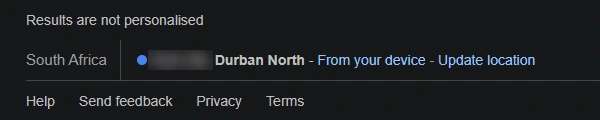
If your competitor is still above you after that, they really are outranking you for that search. Here’s why that usually happens.
Are they paying for that spot?
Check for a “Sponsored” label. If you see one, your competitor is paying for that position through Google Ads. That spot has nothing to do with how well their website ranks.
Ads don’t affect the normal results. Google says it never accepts money to include or rank sites in its search results. So if your competitor is paying to sit at the top, the question becomes whether ads make sense for you too. Your SEO may be in perfectly good shape. If you advertise yourself, Google’s Ad Preview and Diagnosis tool lets you check your ads without clicking on them and wasting budget.
Is it the map results or the normal results?
Google shows two main types of results for local searches, and they rank differently:
- Map results come from Google Business Profiles. They’re mostly about your profile, your reviews and how close you are.
- Normal results are mostly websites. They’re about your pages, your technical setup and your links from other websites.
It’s common to beat a competitor in one and lose to them in the other. Working out which one they’re winning in tells you where to focus.
They might be closer to the person searching
For map results, distance matters. Google says local results are mainly based on relevance, distance and prominence. If someone in Durban North searches for a service, a business down the road has a natural head start over one in Pinetown.
You can’t change where your business is, and you shouldn’t fake an address. What you can do is improve the other two: relevance and prominence. I explain how in how to show up in “near me” searches.
Their Google profile and reviews could be stronger
A lot of the time, it comes down to their Google Business Profile. They might have filled in every section, picked better categories, added more photos and kept posting updates.
Reviews are a big part of it. Google says more reviews and positive ratings can help your local ranking, but in my experience the quality of those reviews counts as much as the number. Even if you have more reviews, a competitor with a bunch of detailed ones, from credible, active Google users with established profiles, can come out ahead. A couple of strong, specific reviews can move the needle more than lots of one-liners.
The fix is a steady stream of genuine reviews from all your customers. Just don’t offer incentives or only ask your happiest clients, which Google’s review policy doesn’t allow.
Their page answers the question better
Your pages may simply be vague. Being specific is far preferable to being vague, and that matters even more in the age of AI, when tools like ChatGPT and Google’s AI Overviews pull content straight from your page to answer questions.
Compare “We offer quality services to all our clients” with “We repair and replace geysers in Durban North, Umhlanga and La Lucia, usually within 24 hours.” The second answers the question someone is actually asking. Google’s guide to helpful content asks whether a page gives a substantial, complete answer. If your competitor’s page does and yours doesn’t, they’ll often win. More on this in how to get your business found on ChatGPT and other AI tools.
Other websites are vouching for them
Backlinks are links to your website from other websites. Think of them as references. Google says one of the ways it judges quality is whether other prominent websites link or refer to the content.
If your competitor has been mentioned in local news, listed in industry directories, featured on suppliers’ websites or linked from community organisations, all those references add up to credibility you don’t have yet. Quality matters far more than quantity, though. Buying links breaks Google’s spam policies and can do more harm than good.
Their website may be in better technical shape
This is where a lot of small businesses lose out without realising it. Their competitor’s website might simply be better built behind the scenes.

Schema markup
Many businesses don’t know about schema markup. It’s code added behind the scenes that tells search engines what your page is about, like your business name, address, opening hours, services and reviews. Google says structured data gives it clear clues about what a page means and can make your listing eligible for richer results. It won’t rank you on its own, but it removes guesswork and adds context and credibility signals.
Page speed
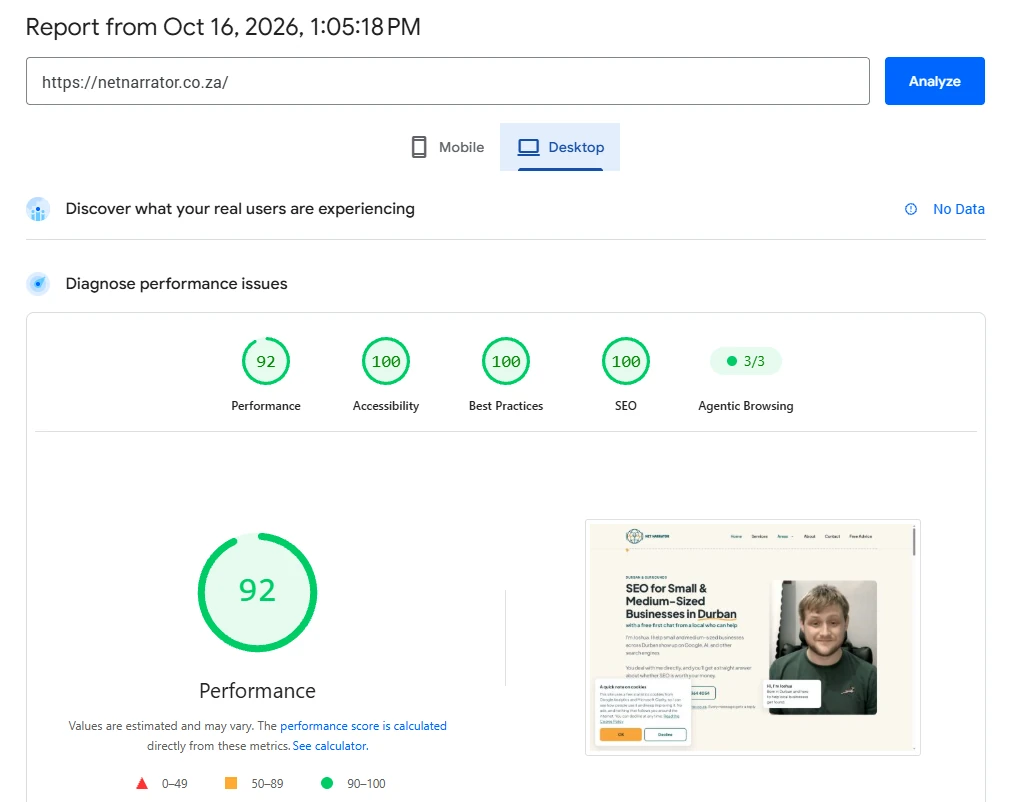
Your competitor’s pages might just load a lot faster than yours. Google highly recommends good Core Web Vitals, its measures of loading speed, responsiveness and visual stability. You can test any page for free with PageSpeed Insights.
Optimised images and videos
Huge, uncompressed images are one of the most common reasons small business websites are slow. Properly sized and compressed images, and videos that don’t load until they’re needed, make a real difference.
Caching and a CDN
A lot of small business websites don’t use caching, which stores ready-made copies of your pages so they don’t have to be rebuilt for every visitor. Some competitors also use a content delivery network (CDN) like Cloudflare, which serves your pages from servers closer to the visitor. Both can make a website noticeably faster. Cloudflare explains how caching works if you’d like the detail.
They’ve simply been around longer
Your competitor’s website may have been around for much longer than yours. Site age on its own isn’t a ranking factor. Google’s John Mueller has said domain age doesn’t matter. But an older website has usually had years to gain credibility, attract visitors, build good engagement signals and grow into something much more extensive, with more pages covering more topics.
That gap can be closed, but it takes time. I explain realistic timelines in how long SEO takes to work.
Sometimes they’re just putting in more work
Sometimes, the honest answer is that your competitor has someone like me working for them. Every month, they’re making improvements, building backlinks, adding local citations and making sure their details are consistent everywhere.
That last one is called NAP consistency: your business name, address and phone number. If those details differ across your website, your Google profile and different directories, Google gets an inconsistent picture of your business, and you can lose some of its trust. A competitor with matching details everywhere looks more reliable.
Not sure which of these is holding you back? WhatsApp me for a free first chat.
How to work out what’s really going on
Before you change anything, find out where the gap actually is:
- Search the terms you care about in a private window, signed out, and note who appears in the ads, the map results and the normal results.
- Compare your Google Business Profile with theirs: categories, photos, posts, and the number and quality of reviews.
- Compare your page with theirs for the same search. Which one answers the question more clearly and specifically?
- Run both websites through PageSpeed Insights and see whose pages are faster.
- Search for their business name and see where else they’re mentioned online.
- Check your own average position in Google Search Console over the last few months.
By the end, you’ll usually see a pattern, whether it’s reviews, content, speed or references.
So how do you close the gap?
Fix the biggest gap first, then keep going. In practice, that usually means:
- getting your Google Business Profile complete and active, with a steady stream of detailed reviews
- rewriting vague pages so they answer real questions specifically
- speeding up your website, compressing images and setting up caching
- adding schema markup so search engines understand your business
- making your name, address and phone number match everywhere
- earning genuine mentions and links from relevant local and industry websites
It won’t happen overnight, especially if your competitor has years of work behind them. But consistency wins. For the bigger picture, read how to get found on Google.
Questions Durban business owners ask about competitors on Google
Can I see what SEO my competitor is doing?
Some of it. You can see their Google profile, their reviews, how their pages are written and how fast their website loads. Paid SEO tools can also estimate which keywords they rank for and who links to them. What you can’t see is everything happening behind the scenes, which is where an SEO audit helps.
Should I copy my competitor’s content?
No. Copying their content won’t help you outrank them, and Google’s guide to helpful content rewards original information. Use their pages to spot gaps, then write something more specific and useful, based on your own experience.
What if their listing looks fake?
If a competitor’s Google profile looks fake, like a made-up address or a business name stuffed with keywords, you can suggest an edit or report it through Google Maps. Google’s contribution policies cover fake and misleading content. Stick to reporting genuine problems, though.
Can a competitor hurt my rankings?
It’s rare. Google is generally good at ignoring spammy links pointed at your website. Fake negative reviews do happen, and you can flag reviews that break Google’s policies. Your best defence is a strong profile and website, and a steady stream of genuine reviews.
Want to know why your competitor is ahead?
Every situation is different, and the fastest way to close the gap is knowing exactly where it is. Your first chat with me is free. I’ll compare your website and Google profile with the competitors above you, tell you honestly what’s holding you back and what I’d fix first. If SEO isn’t the right move yet, I’ll say so. You can also see how my SEO services work.